


ILG Alumni Network at the 30th International Congress of CLAD
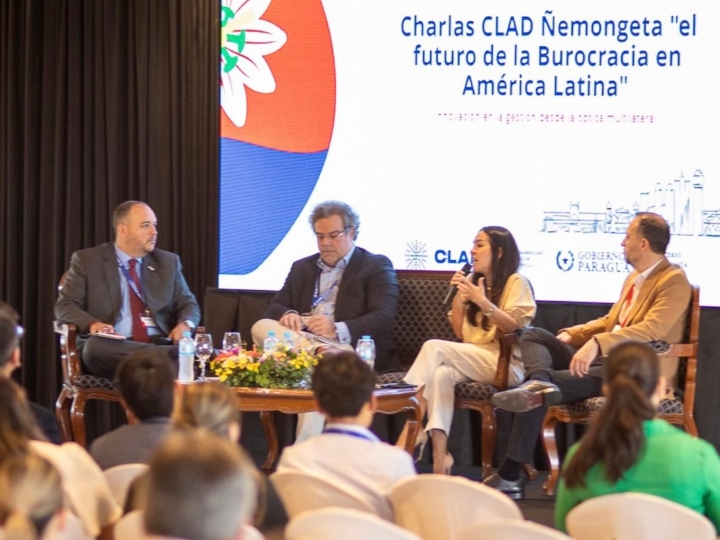
As part of the 30th International Congress of the Latin American Center for Development Administration (CLAD) on State and Public Administration Reform, held from November 10 to 13, 2025, in Asunción, Paraguay, the ILG alumni Network participated in the panel titled “Innovative Leadership in Latin America,”moderated by LALP guest lecturer Silverio Zebral.
By: Carlos Mendoza (ILG 2017, Chile) and Guadalupe Ramírez
The central theme of the meeting, “Innovation, inclusion, and resilience: building States for the future,” brought together authorities, experts, and civil society representatives to debate ways to modernize, promote equity, and drive innovation in the public sector. The edition had approximately 1,500 attendees and was organized in collaboration with the Ministry of Economy and Finance of Paraguay, through the Vice Ministry of Human Capital and Organizational Management.
Andrea Picaso (ILG 2017, Paraguay), Vice Minister of Human Capital and Organizational Management of the Ministry of Economy and Finance of Paraguay; Patricio Lloret (ILG 2022, Ecuador), Advisor to the CLAD General Secretariat; and Javier González (ILG 2017, Panama), Business Developer at UNIVET, participated in the panel “Innovative Leadership in Latin America,” moderated by Silverio Zebral, Head of Academic Affairs and Research at the OAS School of Governance and guest lecturer in LALP academic programs.
Also attending the event were Francia Montero (ILG 2024, Dominican Republic) and Claudia Palazón (ILG 2021, Paraguay). After the event, Patricio Lloret expanded on the challenges and opportunities in public innovation, the professionalization of public servants, and regional opportunities in the following interview:
How does CLAD define its mission in transforming the State in Latin America?
We define it as promoting technical cooperation, training public officials, and exchanging knowledge and experiences regarding State reform and the modernization of public administration. This means connecting countries, institutions, and professionals to facilitate debates and networks that drive improvements in public management. In the current context, marked by digital transformation and citizen demands for greater efficiency and transparency, CLAD seeks to ensure that State transformation in the region is synonymous with building more inclusive, democratic, and effective States capable of responding to population needs and reducing inequalities. For this reason, we emphasize the importance and necessity of multilateralism and regional integration to address common challenges.
What does CLAD understand by “public innovation,” and how does it differ from administrative modernization?
For CLAD, public innovation refers to finding new ways to create public value. For example, creating citizen co-creation mechanisms or using AI for personalized policies are forms of public innovation because they change the paradigms of how government action is formulated, rather than only optimizing the status quo. Modernization means doing existing things better; innovation means doing new things or doing them differently, aimed at generating greater public value and solving public problems in novel ways.
What new competencies should public officials acquire to lead innovation processes?
There are several, but in summary, the profile of an innovative public servant must combine technological mastery, strategic vision, soft communication skills, empathy with citizens, networking ability, and adaptability. With these competencies, public servants will be better prepared to guide teams and organizations to innovate for the benefit of society.
What role do continuous training and organizational learning play in State transformation? Regarding this point, what contributions can be made from your experience as an ILG program participant?
Both are essential: given changing public challenges, institutions must continuously improve and promote a culture of lifelong learning. This implies managing knowledge—documenting processes, sharing best practices, and offering in-service training—so that the State can adapt, correct mistakes, and scale its successes.
My experience as an ILG alumni confirms the value of continuous education. ILG brought together public service professionals from different countries to learn new methodologies and share innovative experiences. Three key lessons were: 1) understanding that innovation emerges from learning communities, like those promoted by ILG in the region; 2) fostering an institutional learning mindset through practices such as post-project evaluations and alumni networks that continue sharing knowledge; and 3) incorporating practical tools such as adaptive leadership and public design thinking.
What opportunities exist today for Latin American States to share knowledge and public innovation projects?
There are various spaces for learning and exchange, such as the CLAD congress, networks promoted by the Development Bank of Latin America and the Caribbean (CAF), the Inter-American Development Bank (IDB), and the OECD; international public leadership programs such as ILG; and open knowledge digital platforms that facilitate sharing tools, experiences, and best practices to improve public management.
What should the public innovation agenda be for the next ten years in Latin America?
In the next decade, Latin America must consolidate a public innovation agenda aimed at building a smarter, more inclusive, and transformative State, based on five strategic axes: deepening digital transformation with an ethical and inclusive approach—integrating technologies such as artificial intelligence and big data with solid governance frameworks and digital gap reduction; strengthening an open, transparent, and citizen-centered State where participation and accountability are the norm; promoting innovations for social and territorial inclusion, incorporating gender and diversity perspectives; strengthening state capacities and an innovative public culture, with trained talent, institutionalized laboratories, and a forward-looking approach; and promoting regional cooperation and active global exchange to share standards, platforms, and learning, moving toward a resilient, collaborative State focused on social well-being.