


Public Innovation: Toward More Efficient, Sustainable, and People-Centered States
For Patricio Ovalle (ILG 2025, Chile) and Luis Papagni (ILG 2025, Argentina), public innovation goes beyond the adoption of technology: it is a tool for transforming government management and sustainably improving people’s quality of life. Its impact depends on strengthening institutional capacities, trust, collaboration, and the continuity of initiatives with a long-term perspective that transcends government cycles. In this context, Latin America and the Caribbean have an opportunity to bring together the public, private, academic, and social sectors to develop citizen-centered solutions and move toward more agile, resilient, and people-centered states.

by Guadalupe Ramirez
In a joint conversation, both alumni of the Innovation and Leadership in Government (ILG 2025) cohort share their motivation to become agents of change, their perspectives as leaders advancing public innovation, the factors that determine its success, and the opportunities across Latin America and the Caribbean.
Different Paths, One Shared Purpose: Innovating in the Public Sector
With very different academic and professional backgrounds, Luis, who holds a degree in Information Systems Engineering and a solid career spanning more than 22 years in the public sector, and Patricio, a commercial engineer and MBA from Universidad del Desarrollo, with executive training in innovation, entrepreneurship, and public-sector transformation through Georgetown University’s ILG program, IE University, and Babson College, have both found in the public sector and public innovation a deep motivation to create meaningful impact.
For Patricio Ovalle Wood, Director of the City Hub at the MIT–University of Guadalajara City Science Lab and former Senior Innovation Advisor at the Inter-American Development Bank (IDB), it is essential to distinguish between invention and innovation. An invention can be a novel idea, technology, or solution; it becomes an innovation when it is adopted, creates value, and addresses a specific problem. In the public sector, that value must translate into better services, greater trust, and an improved quality of life. Public innovation also requires spaces built on trust, as it is unlikely to thrive in institutions dominated by suspicion, silos, or fear of failure. This underscores the need to bring together the capabilities of government, businesses, academia, and civil society to address challenges that no single actor can solve alone.
His career as a competitiveness consultant and his professional experiences in Chile, Europe, and the United States showed Patricio that governments could be more efficient, agile, and collaborative by adopting new methodologies, technologies, and ways of engaging with their broader environment. As Director of Development at the Municipality of Providencia, he launched Hub Providencia in 2017, Chile’s first municipal innovation hub. Later, at the Inter-American Development Bank (IDB), he brought these lessons to the regional level through the creation of the City Hub. Today, under the institutional framework of the MIT–University of Guadalajara City Science Lab, this platform brings together more than 30 governments and public institutions from 12 countries across Latin America and the Caribbean to transform shared challenges into collaborative, replicable solutions with the potential to endure beyond political cycles.
In Latin America and the Caribbean, Patricio notes, it is not enough to spend more; it is essential to spend better and to innovate in the way the state designs, implements, and evaluates public policies. The IDB has estimated that inefficiencies in public procurement, targeted transfers, and public-sector compensation amounted to 4.4% of regional GDP; an update published in 2025 placed this figure at 4.6% of GDP for a group of 15 countries in 2022. Another, distinct but equally relevant gap concerns research and development: according to the OECD, the region has invested around 0.65% of GDP in R&D, compared with approximately 2.7% in OECD countries. These indicators do not measure the same thing, but they point to a common challenge: strengthening public-sector capabilities, mobilizing knowledge, and turning limited resources into better outcomes for people.
“Public innovation must bring together worlds that today operate in isolation: breaking down silos, connecting capabilities, and turning technology into better services, greater trust, and a higher quality of life for people.” – Patricio Ovalle (ILG 2025, Chile)
For his part, when Luis, a consultant and strategic advisor on Digital Public Infrastructure (DPI), Digital Identity, Cybersecurity, and Interoperability, began his career in the public sector, he recognized the unique multiplier effect created by combining public management and technology: reaching millions of people with a single solution, reducing inequalities, and driving deeper change. It was no longer simply about migrating systems, but about understanding the challenges involved in reaching communities through projects with clear governance, digital sovereignty, and long-term sustainability.
In countries across the region where public policies are often short-term, the combination of technology and innovation creates an opportunity to develop sustainable public policies with longer-lasting and broader impact.
Accept, Adapt, and Own: Keys to Success
From his perspective, innovation requires long-term sustainability. A digital transformation project, for example, is successful when it survives beyond a single administration. Achieving this requires several factors: 1) institutional capacity, including governments with clear rules, regulatory frameworks, and structures that can turn projects into state policies rather than initiatives that disappear shortly after they are created; 2) open standards that allow systems to connect and scale without depending on a single provider; 3) in-house capacity, with trained technical teams capable of maintaining and evolving what has been built; and 4) change-management capabilities to address emerging challenges.
“A strong public innovation project goes through three stages: acceptance, adaptation, and ownership. When it reaches the third stage, and it is embraced by government leadership, technical teams, and citizens alike, it can be considered successful.” – Luis Papagni (ILG 2025, Argentina)
One example, he continues, is Argentina’s digital processing system, which remains in operation more than 10 years after its implementation. Previously, people who needed to process their identity documents had to appear in person, make repeated visits, and wait six to eight months.
Following the changes introduced in 2010, people applying for an identity document, including a passport, can begin the process and receive it at home within a few hours or several days. For citizens, it is now difficult to imagine the process working any other way. It is a sustainable model in which the technology is updated as needed, and it has been successful because both citizens and public institutions have accepted, adapted to, and taken ownership.
Continuity and Long-Term Trust, Beyond Political Administrations
For Patricio, those who innovate in the public sector often spend too much time justifying their work and too little time institutionalizing it. For this reason, he argues that sustainable public innovation is not possible without political support and commitment. Authorities must create an environment where experimentation, learning, and risk management are possible; but the fundamental challenge is to turn these projects into institutional frameworks: rules, capabilities, resources, and governance mechanisms that belong to the state and do not depend exclusively on the government in office.
In Latin America, he continues, the main obstacle is not a lack of talent or ideas, but institutional fragility: short-term incentives, leadership turnover, uneven capabilities, and limited policy continuity. Faced with urgent challenges in education, health, public safety, productivity, and social cohesion, innovation cannot be reduced to a succession of pilots. Scaling and sustaining solutions requires governance, skilled teams, resources, evaluation, and leaders capable of mobilizing the organization.
Chile offers examples of how institutional continuity and cross-sector collaboration are possible. Since 1990, successive administrations have built on previous policies, even when they have belonged to different political coalitions. Start-Up Chile, created in 2010 at the beginning of President Sebastián Piñera’s administration by the Ministry of Economy and implemented by Corfo, became the world’s first public startup accelerator and positioned the country as a leader in technology-based entrepreneurship. Later, during President Michelle Bachelet’s second administration, the network of Sercotec Business Development Centers began to be rolled out, inspired by the Small Business Development Centers (SBDC) model. Today, the network has 62 centers and more than 200 service locations across Chile. This ability to sustain, adapt, and scale policies across administrations, he adds, remains the exception that should become the rule.
Luis adds that Latin America has the talent needed to innovate, and that several countries have made significant progress in digital transformation. However, there are also structural challenges, including fragmentation, where institutions end up solving the same problems separately without interoperating with one another. As a result, public innovation is constrained and unable to scale. This is also part of institutional discontinuity, as changes in government can lead to processes being restarted rather than built upon what already exists.
Maintaining an optimistic yet realistic perspective, he also believes that the focus must remain on citizens and their trust in institutions, particularly when it comes to the protection and use of their data. Governments today have an opportunity to view innovation as a public good and, drawing on the Sábato Triangle, bring academia, government, and the private sector together in a coordinated manner to create consistent, trust-based processes.
ILG: A Call to Transform the Region
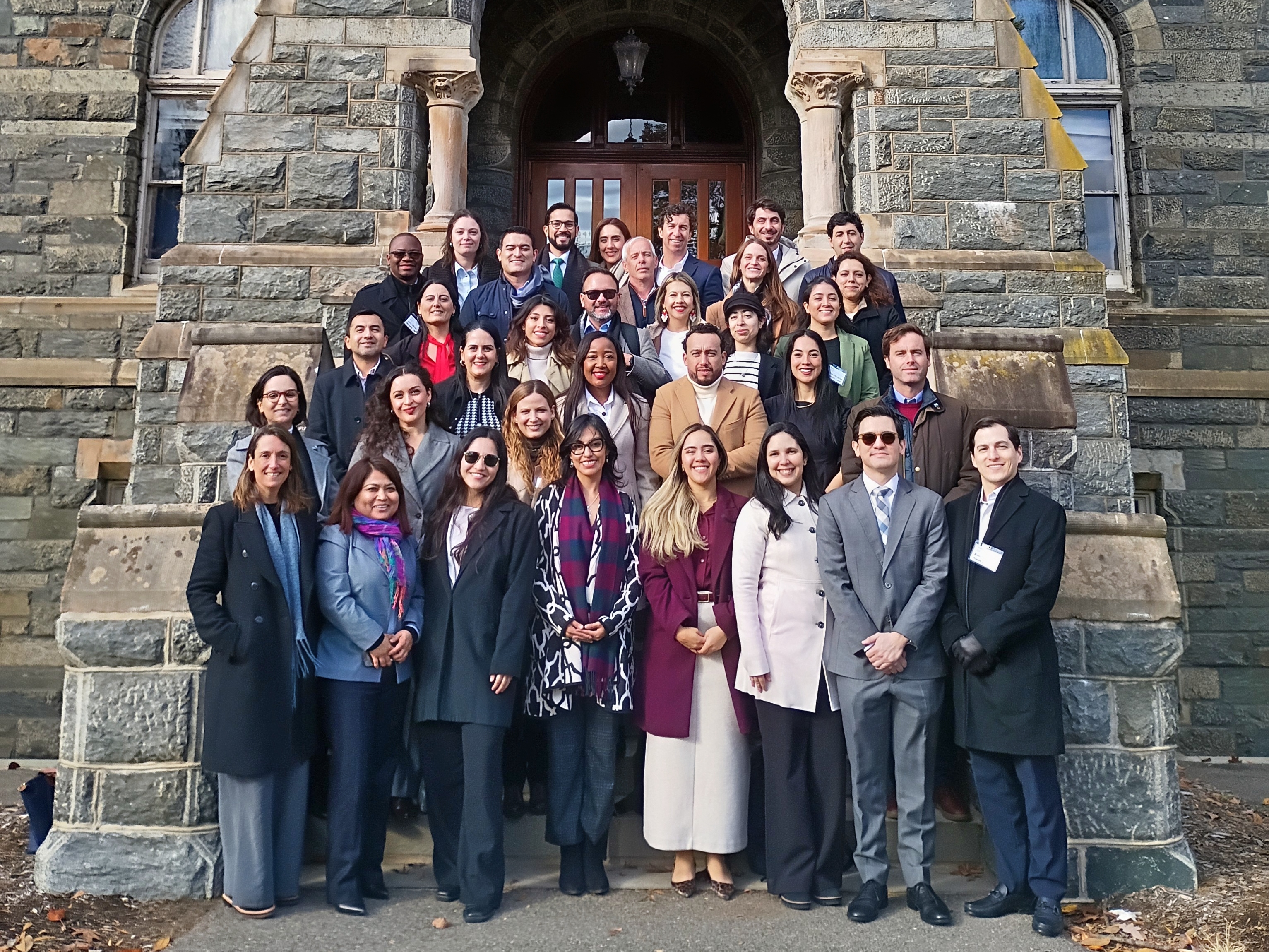
In a final reflection, and as they shared their experiences in the ILG program, both agreed that the program gave them the opportunity to connect with public-sector colleagues from different countries, confirming that many challenges are shared, that none can be solved alone, and that regional integration is no longer simply a romantic ideal, but a viable strategy—especially when compared with developments in other regions. They emphasized that the program not only equips participants with technical skills, but also develops individuals capable of leading change and building the networks the region needs today to become more connected and collaborative.
They both agree that the program brings together talented people with a genuine passion and commitment to improving people's quality of life. It empowers them, but also serves as a call to action: from wherever they are and whatever their role, they are encouraged to make a meaningful difference. As they learned at ILG: “If not us, who? If not now, when?”
Thank you, Patricio and Luis, for your genuine commitment to public innovation across the region!