


Ledénika Méndez, ILG 2023, Mexico, Winner of the 2026 ILG Impact Award
Ledénika Méndez, ILG 2023, has been named the winner of the 2026 ILG Impact Award for her strategic vision and innovative public leadership in the project Smart Villages, Sustainable Wellbeing. A fundamental part of this success has been fostering collaboration among government, civil society organizations, and the private sector through the establishment of agreements and legal instruments benefiting historically marginalized rural communities. Free Internet access has transformed geographic isolation into connectivity, empowering communities to strengthen their digital skills, economy, and overall wellbeing.

By Guadalupe Ramirez
The ILG Impact Award serves a triple purpose: to identify and promote emerging innovative public policy practices in Latin America and the Caribbean in response to this challenge; to contribute to the exchange of experiences, capacity building, and visibility of the region’s contributions to public innovation processes at subnational, national, and regional levels; and to strengthen the ties of LALP alumni networks with Georgetown University.
This year, the recognition is awarded to Ledénika Méndez, current Commissioner of the Telecommunications Regulatory Commission in Mexico, for applying what she learned in the program to her Smart Villages, Sustainable Wellbeing project and scaling it up. Her work has improved its implementation and transformed the lives of more than 100,000 beneficiaries who, through satellite Internet connectivity, now have tools for the economic development of their communities while preserving their cultural heritage. She has also actively represented the program as an alumna and remained connected to the alumni network.
During the pandemic, when Ledénika first heard about the Innovation and Leadership in Government (ILG) program, what most caught her attention was that a university in the United States was interested in the challenges facing Latin America, the focus on developing public leaders, access to global and regional experts, and the support provided for the development of each project throughout the program.
Smart Villages, Sustainable Wellbeing: A Scalable Model
Although part of the Smart Villages, Sustainable Wellbeing model was already advanced when Ledénika presented her project, she put into practice what she learned during the program to scale the innovation and enhance the model’s reach and impact.
Article 6 of the Political Constitution of the United Mexican States establishes that the State must guarantee access to ICTs, broadcasting, telecommunications, broadband, and the Internet. In compliance with this mandate, the Ministry of Infrastructure, Communications and Transportation (SICT) created the Smart Villages, Sustainable Wellbeing model, which goes beyond providing connectivity by actively promoting the development of digital skills and capacities.
“Smart Villages, Sustainable Wellbeing is a digital inclusion model aimed at promoting digital access in public spaces associated with a productive project chosen by the community, through meaningful Internet connectivity in rural and/or hard-to-reach areas, especially those predominantly inhabited by women or Indigenous populations, with the goal of improving their quality of life. The model consists of four essential phases: 1) Access, 2) Use, 3) Appropriation, and 4) Wellbeing,” Ledénika Méndez.
The model unfolds in four phases: Access that provides connectivity in public spaces linked to productive projects, Use that promotes services and models such as fair trade, financial inclusion, and digital literacy, Appropriation that encourages economic activities and community innovation based on connectivity, and Wellbeing that fosters knowledge exchange and reduces digital divides. Together, these phases address coverage, connectivity, and the effective use of technology.
From its conception, the model was inspired by the International Telecommunication Union’s (ITU) smart village concept, which aims to reduce the digital divide in rural areas, as well as by the UN 2030 Agenda Sustainable Development Goals (SDGs), which seeks to enhance quality of life and bridge social, economic, and technological gaps.
During the Appropriation phase, Ledénika promoted partnerships with organizations such as Pro Mujer and Active Digital Aging to strengthen digital literacy, promote the role of “ICT Ambassadors,” and provide workshops for older adults on technology use.
The model evolved to connect island territories through a new concept known as Smart Islands. Areas such as Isla Margarita in Puerto Alcatraz, Baja California Sur - whose replicable project was also developed during ILG - became Super Villages equipped with greater technical capacity, coinciding with increased support from satellite operators.
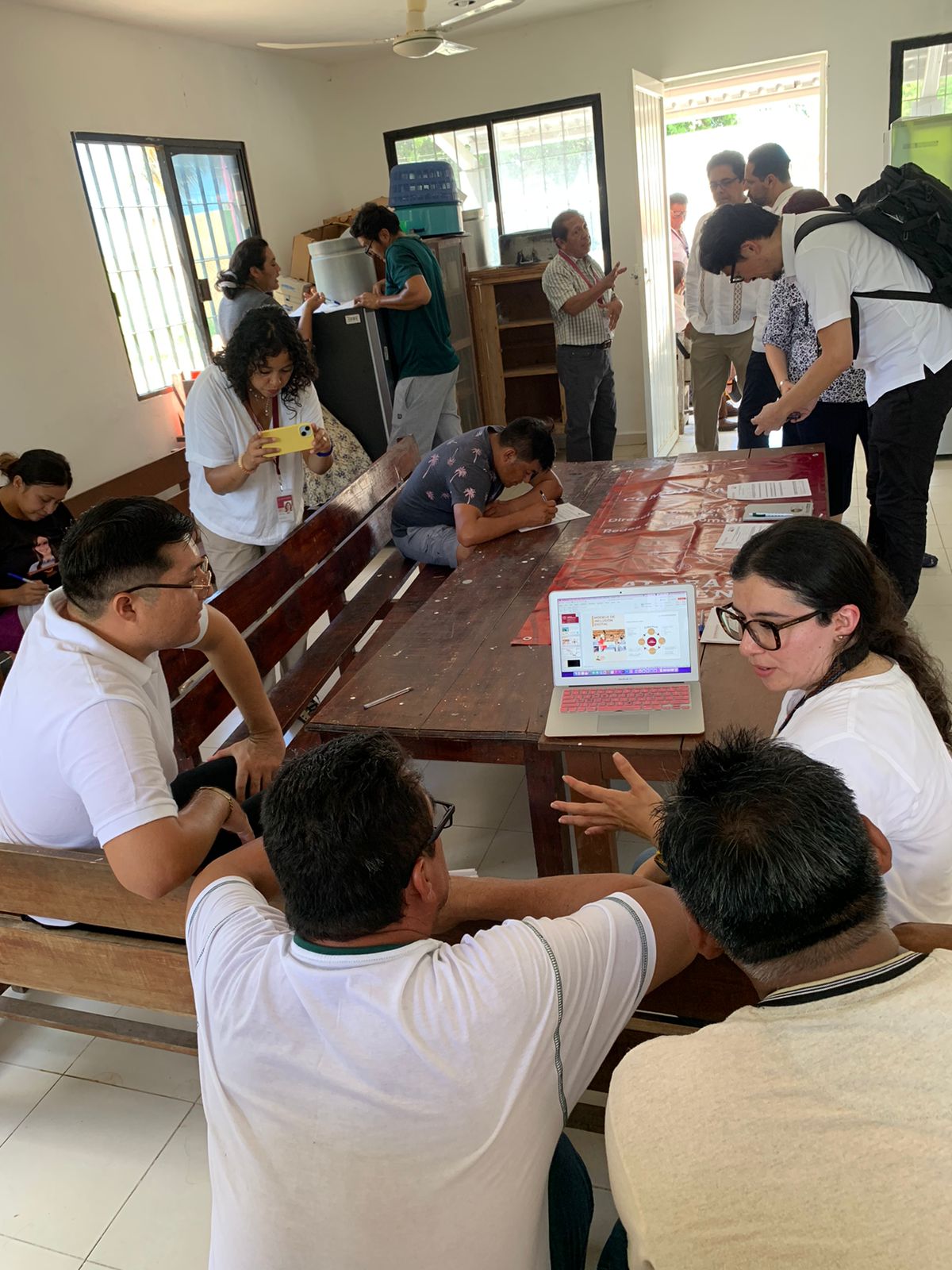
“By the end of 2024, there are 83 Smart Villages across 17 Mexican states transforming the lives of more than 100,000 people, over 50% of whom are women, 35,000 belong to Indigenous communities, and 5,000 have disabilities. The goal is to expand to more states across the country,” Ledénika Méndez.
Leadership and Collaboration for the Common Good
Ledénika highlights that the initial challenges - such as limited funding, lack of monitoring tools, and
continuity - led to solutions including engaging private and social actors and using digital platforms to track progress. The model’s success lies in the collaborative network among the public, private, and social sectors, primarily benefiting rural, Indigenous, and women populations, thanks to the leadership and collaboration of the Government of Mexico, local authorities, civil society organizations, private operators, and international bodies such as the Mexican Agency for International Development Cooperation (AMEXCID).
Her participation in national and international forums has further strengthened her role as an ambassador of the Smart Villages model.
“A key lesson from the model is that innovation and social impact do not depend solely on government budgets: by bringing together different stakeholders and applying the right mechanisms, it is possible to improve the lives of communities without access to technology and expand their enjoyment of other rights,” Ledénika Méndez.
Through the 2024–2026 Mexico–Brazil Technical Cooperation Program, promoted by AMEXCID and the Brazilian Cooperation Agency (ABC), efforts are underway to replicate the digital inclusion model in vulnerable populations in Brazil. Additionally, interest from the Japan International Cooperation Agency (JICA) may open new opportunities to expand the project to Central America, leveraging Mexico’s experience and Japanese technology to reduce the regional digital divide.
The ILG Network: Inspiration, Connection, and Opportunities for Transformation
During her participation in ILG, Ledénika valued the opportunity to openly exchange each country’s challenges and their regional impact, as well as the motivating support she received. From the outset, she stood out for her enthusiasm to learn, collaborate, and contribute.
Throughout the program, she realized that sharing experiences across different roles and organizations makes it possible to improve policies, optimize resources, and avoid design or implementation errors. For Ledénika, one of the greatest lessons was that thinking big also means acting locally with a regional vision.
Since then, she has become a reference point for her cohort due to her proactive spirit and ability to connect with participants, representing them on the Board over the past two years. Recognizing the value of the ILG Alumni Network, she focuses her energy on strengthening connections among alumni in her cohort.
From LALP, we extend our congratulations to Ledénika for this well-deserved recognition, highlighting her innovation, commitment, and positive impact, making her a role model for future generations.
Bio: Ledénika Méndez
Ledénika holds a Ph.D. in Law from the National Institute for Legal Development, a Master’s degree in Public Administration from the National Institute of Public Administration, and a Bachelor’s degree in Political Science and Public Administration from the National Autonomous University of Mexico (UNAM).
With more than 20 years of experience in social inclusion, telecommunications, and digital innovation projects, she has participated in international forums such as CLAD, IGF, and the GLI Forum. She has served as an academic at UNAM and as a guest professor at the University of Cádiz. She is an Ambassador of the Latin American and Caribbean Institute for Economic and Social Planning (ILPES) and a collaborator at the Virtual Center for Public Management Studies.
Source: Ledénika Méndez (ILG 2023) and ILG Alumni Network